
Quick answer: Most homes in Fairfield County should have their siding soft washed every 1 to 2 years, their roof soft washed every 2 to 5 years, and high-traffic concrete like driveways cleaned once a year. Homes in shaded, wooded, or coastal areas usually need cleaning on the more frequent end of those ranges. The right schedule comes down to your siding, your surroundings, and how much shade and moisture your property gets.
Ask ten homeowners how often they should power wash and you will get ten different answers. The honest answer is that it depends on the surface and on where in the county you live. A shaded colonial up in Greenfield Hill and a shingle-style home near Penfield Beach are not on the same schedule, and treating them like they are leads to either wasted money or a house that quietly deteriorates.
We clean homes across Fairfield County every week, from the coast to the wooded hill towns, so we built this guide around what actually happens to homes here. Below is a surface-by-surface schedule, the reasons behind each interval, and how your specific location changes the math.
How Often Should You Power Wash Your Home? The Short Answer
For most Fairfield County homes, the siding needs attention every 1 to 2 years, and high-traffic concrete like driveways benefits from a yearly cleaning. That is the baseline. Your surroundings move you up or down from there.
One point of confusion worth clearing up right away: “power washing” gets used as a catch-all, but most of your house should not be blasted with high pressure at all. Siding and roofs should be soft washed, while hard flatwork like driveways and patios can handle true pressure washing. We break down the difference further down, but keep it in mind as you read the schedule.
Nationally, once or twice a year is enough for most homes to keep mildew, algae, and dirt from building up. Fairfield County pushes many homes toward the more frequent end of that range. We average roughly 48 to 50 inches of precipitation a year, well above the national average of about 38 inches, and our humidity sits in the 70% to 76% range for much of the year. Those are the exact conditions mold and algae love. Rather than hand everyone the same schedule, we look at each property and recommend what it actually needs.
Fairfield County Power Washing Schedule, Surface by Surface
Here is how often each part of a typical home in our area needs cleaning, from siding and roofs down to driveways and decks and patios, along with the reason behind each interval.
| Surface | How often (Fairfield County) | Method | Why this interval here |
| House siding (vinyl, Hardie, aluminum) | Every 1–2 years | Soft wash | Humidity and shade drive mold and algae on north-facing walls; annual in coastal or shaded spots |
| Cedar shake / painted wood siding | Every 1–2 years, gentle | Soft wash, low detergent | Common on the coast; high pressure lifts the grain and greys the wood, so it must be soft washed |
| Roof (asphalt shingle) | Every 2–5 years | Soft wash only | Black streaks are living algae that feed on the shingles; shaded, wooded lots trend to the 2–3 year end |
| Driveways, walkways, patios (concrete/pavers) | Once a year | Pressure wash | High-traffic flatwork collects oil, dirt, leaf tannins, and slippery organic film |
| Bluestone / natural stone patios and walls | Once a year | Soft wash / low pressure | Porous stone is common here; high pressure etches and pits the surface |
| Wood or composite decks | Once a year, or as needed | Soft wash / low pressure | High pressure splinters wood and can damage composite finishes |
| Gutters (exterior “tiger stripes”) | With each house wash | Soft wash + brightener | Oxidation and algae streak the fascia, so we clean it alongside the siding |
| Gutters (interior debris) | Twice a year | Hand clean and flush | Leaf drop from heavy tree canopy clogs gutters in spring and fall |
Two rows deserve a closer look.
The roof is the one people put off the longest, and it is the one where waiting costs the most. Those black streaks are not dirt. They are a living algae called Gloeocapsa magma that feeds on the limestone filler in asphalt shingles. Left alone, it holds moisture against the surface and spreads across the whole roof. Removing it protects the shingles you already paid for, which is why our roof cleaning always uses a soft wash rather than scrubbing or blasting.
Siding sets its own schedule based on which walls green up first. North-facing and tree-shaded walls hold moisture longer and grow algae before the rest of the house does. When we clean a home, we soft wash all of it, but those shaded walls are usually the reason a home lands on the yearly end of the range.
If you want to know what a cleaning like this runs, we cover it in detail on our guide to how much power washing costs in Fairfield County.
Why Fairfield County Homes Get Dirty Faster
Our climate is the reason the intervals above skew more frequent than what you would see in a drier part of the country.
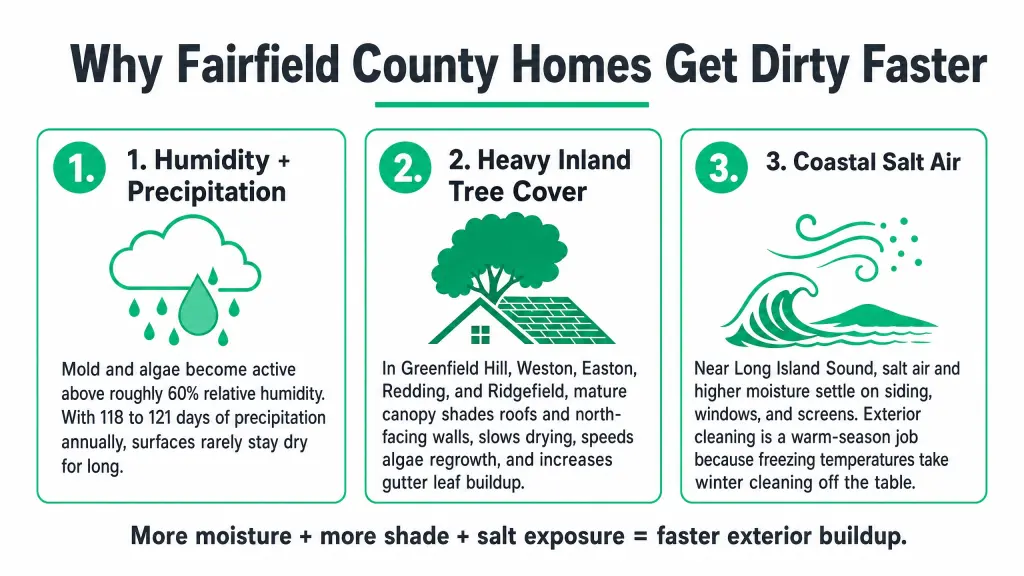
Mold and algae become active once relative humidity climbs above roughly 60%. Fairfield County sits above that mark for much of the year, and with 118 to 121 days of some kind of precipitation annually, surfaces rarely stay dry for long. That combination of moisture and warmth is what turns a clean north wall green over a single season.
Tree cover makes it worse inland. In towns like Greenfield Hill, Weston, Easton, Redding, and Ridgefield, mature canopy keeps roofs and north-facing walls in shade, so they dry slowly and regrow algae faster. The same trees drop leaves that pile into gutters twice a year, which is why regular gutter cleaning matters more on wooded lots. If gutters are your main concern, we go into detail on how often you should clean your gutters in a separate guide.
The coast brings its own problem. Homes near Long Island Sound deal with salt air and higher moisture, which settles on siding, windows, and screens. Winter takes cleaning off the table entirely, since freezing temperatures and water do not mix, so exterior work here is a warm-season job.
Coastal vs. Inland: How Your Location in the County Changes the Schedule
Fairfield County is really two environments, and your home belongs to one of them. This is the part most cleaning schedules ignore.
If you live in a coastal or beach neighborhood, think Southport, the Fairfield beach area, Rowayton, or the waterfront stretches of Greenwich and Darien, salt air and humidity keep your siding on the more frequent end. You will also notice salt film on windows and screens sooner than an inland home would. Annual house washing is usually the right call here.
If you live in a wooded, inland hill town like Ridgefield, Weston, Easton, Redding, or Wilton, shade is your main factor. Roofs and north-facing siding grow algae faster under heavy canopy, so roofs trend toward the 2 to 3 year end of the range, and gutters need clearing more than the usual twice a year because of leaf drop.
If your home is newer suburban stock with vinyl or Hardie siding on an open, sunny lot, common around Trumbull, Norwalk, and parts of Stamford, you are usually fine on the every-1-to-2-years schedule.
| Your situation | Adjust the schedule |
| Beach or coastal, salt air | House wash annually; watch windows and screens for salt film |
| Heavy tree cover or shaded lot | Roof every 2–3 years; clear gutters more than twice a year |
| North-facing walls green up early | Move siding toward annual |
| Newer vinyl or Hardie, open sunny lot | Every 1–2 years is usually enough |
The takeaway is simple: match your schedule to your micro-location, not to a county average.
Can You Power Wash Too Often?
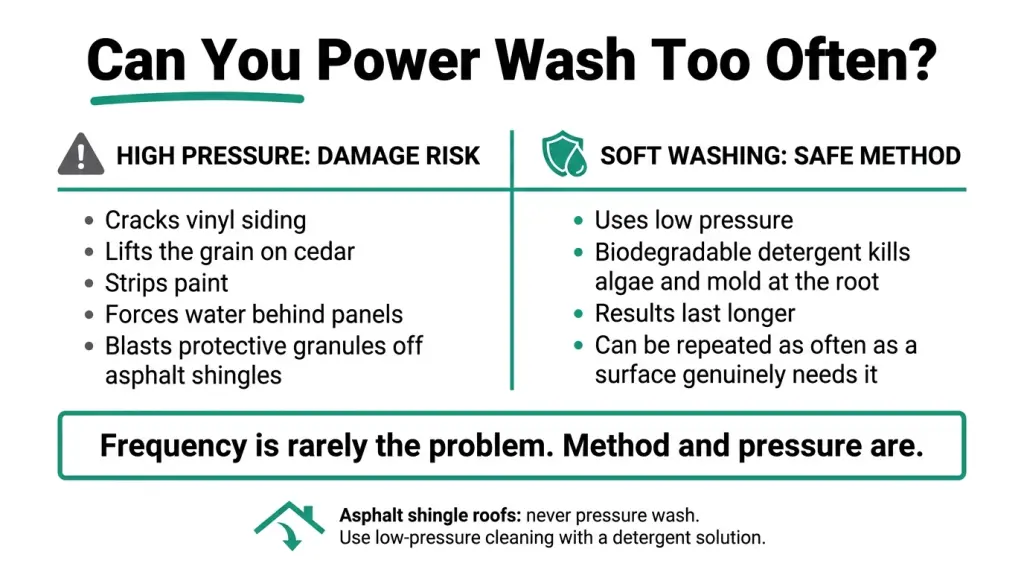
This is one of the most common worries we hear, especially from owners of homes with cedar shake or painted wood trim. The good news is that frequency is rarely the problem. Method and pressure are.
High-pressure washing is what damages a home. On siding, it cracks vinyl, lifts the grain on cedar, strips paint, and can force water behind the panels where it feeds hidden mold. On a roof, it blasts off the protective granules that give shingles their lifespan. That is the damage people are picturing when they worry about washing too often.
Soft washing works differently. It uses low pressure and a biodegradable detergent that kills algae and mold at the root, then rinses clean. Because it kills the growth instead of just knocking it loose, the results last longer, and it can be repeated as often as a surface genuinely needs it without harming the home.
Roofs are the clearest example. The Asphalt Roofing Manufacturers Association is direct about it: never use a pressure washer on an asphalt shingle roof, because it causes granule loss and likely premature failure. Their guidance points to low-pressure cleaning with a detergent solution instead. ARMA also notes that warranty terms are set by your individual shingle manufacturer, so if protecting a warranty matters to you, that is worth checking before anyone touches your roof. If you want to go deeper on this, we cover whether soft washing is safe for roofs in its own guide. You can also read ARMA’s guidance directly on the Asphalt Roofing Manufacturers Association site. It is the reason we soft wash every roof we clean.
The Best Time of Year to Power Wash in Connecticut
Warm and dry is what you want, which in Connecticut means late spring through early fall.
Late spring, once the pollen has settled, is a great time for a first pass. A lot of our customers pair that with a second cleaning in the fall to clear off the organic buildup before winter sets in. Those two windows line up naturally with our pollen season and our leaf drop, so they are easy to remember.
The one time to avoid is winter. Freezing temperatures make exterior washing impractical and risky, so we schedule that work for the warmer months.
Frequently Asked Questions
How many times a year should you power wash your house in Fairfield County?
For most homes, cleaning the siding once every 1 to 2 years is enough, with high-traffic concrete like driveways handled annually. Homes on shaded, wooded, or coastal lots usually benefit from yearly house washing because moisture and organic growth build up faster in those spots.
What is the best time of year to power wash a house in Connecticut?
Late spring through early fall, once the risk of freezing has passed. Many homeowners here schedule a wash after pollen season in late spring and again before winter to clear off organic buildup.
Is it bad to power wash your house every year?
Not if the right method is used. Annual soft washing is safe and often a good idea in humid, coastal, or shaded areas. The damage people worry about comes from high-pressure washing on delicate surfaces, not from cleaning on a regular schedule.
How often should a roof be cleaned in Fairfield County?
Every 2 to 5 years for most asphalt-shingle roofs, and closer to every 2 to 3 years on heavily shaded or tree-covered lots where algae returns faster. Roofs should always be soft washed, never pressure washed.
What is the difference between power washing and soft washing?
Power, or pressure, washing uses high-pressure water for hard surfaces like concrete driveways and patios. Soft washing uses low pressure plus biodegradable detergents to safely clean siding, roofs, and other delicate surfaces while killing algae and mold at the root.
Does power washing help sell a house?
Yes. A clean exterior improves curb appeal and how a home shows, which carries weight in Fairfield County’s fast-moving market where homes often sell quickly and at or above asking. Curb appeal can account for a meaningful share of a home’s sale price, so a wash before listing tends to pay for itself.
Ready for a Clean That Lasts?
If you are not sure where your home falls on the schedule, we can figure that out with you. We will look at your siding, your roof, your surroundings, and recommend a plan that fits your property instead of a generic calendar. We are local, fully licensed and insured, and we soft wash first to protect your home rather than risk it. Call us at (203) 428-7019 for a free, no-obligation quote.